Showing posts with label tennis. Show all posts

Monday, May 22, 2023

Which string type is right for you? Part1

When trying to decide on which tennis string is right for your game, a good place to start is knowing there are four basic types of strings. You can also combine two of the types into a hybrid stringing, but we’ll get to those in another post. In the next several posts, we’ll give some pros and cons to each of these types. We’ll do so from our many, many years of stringing rackets for countless people, and the feedback they have given.

We’ll start with the most basic of the types, synthetic gut. Technically, all stings that are not natural gut are synthetic. What we’re talking about is strings made of nylon with a solid core, wrapped by smaller filaments.

Synthetic gut is a sting that does everything ok. Not great. Not horrible. For someone just getting into the game, it’s a great option because those players rarely have a clear idea of what their needs and preferences are. This makes it a very good springboard into other types of strings, as their needs become more specific.

For power, control and feel, it comes in between the other strings, but can play great for someone who wants a combination of those traits. As for durability, again, it comes in the middle among the strings.

Synthetic Gut is a great option for its price, which is less than the other types. Some frequent string breakers like it for having more pop than the more durable options, while not breaking the bank for each stringing.

Don’t overlook synthetic gut as an option worth trying. If you’re looking for more control than a softer, multifilament string, and more pop and better feel than a poly, they’re worth a try.


Thursday, March 2, 2023

Replacement grip or over grip?


Replacement grip or over grip?


We get asked that question often and there isn’t a one size fits all answer.

The main grip on your racket or pickleball paddle can be replaced with a, you guessed it, a replacement grip. Even if you’re using an over grip, over time, the main grip will lose its cushioning and tackiness. If you feel your grip feels hard or noticeably thinner in your hand, it’s time to get a new grip on there. The added cushioning will improve the feel and if you’re not using an over grip, will reduce slipping on impact.

An over grip, as the name implies, goes over the main grip. Many players like over grips for their ability to absorb sweat and their feel. They’re easy to replace, so for someone with really sweaty hands, over grips can be a tremendous help in providing a more stable hold of the racket or paddle. Over grips will make the handle feel larger, so players with small hands or ones with grips too large for their hands may not like the increased grip size.

Stop by the store and we’d be happy to show you the options and help find the best grip solution for your needs. Best of all, we’ll put them on while you wait.

Sunday, November 13, 2022

Are you wearing the wrong shoes?


Tennis or pickleball, you need the right shoes. 

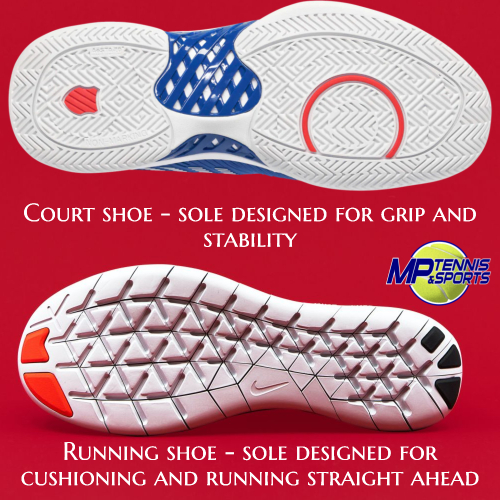
A mistake many make is using running shoes in place of a good court shoe. This decision can have some nasty results. 

Running shoes (and walking shoes) are made to go in one direction, straight ahead. For sports like tennis and pickleball, this is a problem with so much of the movement being side to side. A running shoe’s lack of lateral support can lead to rolled and sprained ankles. If you want to see for yourself, grab a pair of running shoes and see for yourself how much the bend and twist with just your hands. A court shoe for tennis and/or pickleball will be much sturdier, with less flexibility, but way more support for the needs of the court. 

The other issue with running shoes is the soles. Again, they are designed for running straight ahead, not for sudden starts and stops. Court shoes have a firmer sole with a tread pattern designed to grip the court for better stopping and acceleration. 


If comfort or weight is your reason for not getting a court shoe, try on some of the newest shoes. While some are a little heavy, many are very light without sacrificing support and performance, and they even look a little like running shoes. Oh… and they look amazing! 

Stop in and we’d be glad to help you pick the right shoe for your feet, your game and your needs. 

Tuesday, May 17, 2022

Are you getting enough depth on your shots?


Are you hitting your shots deep enough?

If not, you’re probably giving your opponent short balls that they turn into winners. Hitting the ball deep forces your opponent to cover more ground and keeps them at the baseline where, for most amateurs, it’s tougher to hit clean winners. Hitting deep balls also gives you more time to set up for the return shot.

But how to get more depth?

We see several things that can rob you of depth. Strings can be that cause in several ways. One is stringing your racket too tight. This reduces the trampoline effect at impact, taking away depth and even spin potential. Lower tensions can also reduce shock at impact, reducing stress on your arm.

Another potential cause is using to stiff of a string. While poly strings are great for durability, they are stiff and not very elastic. This again reduces the trampoline effect, making you swing harder without getting the depth you need.

One other equipment related reason you’re not getting the depth you want is your racket. A racket with a small head reduces the trampoline effect, and while good for big hitters, could rob you of more depth and power.

Stop in and we’d be glad to help you pick the right string and tension for your game, and with our Racket Demo Program, a racket better suited to your game.


Tuesday, February 11, 2020

Can Strings & Tension Help With Tennis Elbow?


Can a change in your strings or tension help with tennis elbow?
Yes, they can. But there is a catch.
If you have elbow pain from playing tennis, going to a softer string or a lower tension can help reduce some of the shock you may feel at impact. They can also add some depth to your shots with less effort. This will reduce the need to overswing, which can cause some arm issues.
Here is the catch. Strings and tension will not cure tennis elbow. Often the root cause of tennis elbow is in the technique of your swing through impact. Many times it is being to wristy, causing a strain in the elbow. To eliminate tennis elbow, a lesson on the proper technique would be the way to go. If you are just looking for some added comfort at impact, strings and tension can do the trick.
Stop in and we can help you choose the right combination.

Tuesday, November 5, 2019

Want More Control?


Want more control?
First of all, I should be specific about the type of control I'm describing. I'm talking about depth control. The ability to hit the ball consistently deep, but not long.
If this is the kind of control you are looking for, there are a few ways to achieve it though equipment. The first is with rackets. If you are hitting lots of shots long, your racket may be too powerful. A racket with a smaller head, thinner beam or denser string pattern will all reduce depth. This does not come without some cost. With less depth comes less power.
The other way to gain control is with your strings. Going a little tighter on the tension will add some depth control. You can also go to a firmer string. This will decrease the trampoline effect and add control. As mentioned above about rackets, going firmer or tighter on your strings will reduce your power and increase the amount of effort to get the ball deep.
There is another, non-equipment way to add control. Increase your topspin. More topspin will help the ball drop down and in play, keeping you from hitting as many long.
Stop in and we can show you ways to gain control with the least amount of power loss.

Friday, October 25, 2019

Want More Spin?

Spin.
It seems like everyone wants more, but how to get it?First of all, unless you are doing the right things in your swing, equipment really won't help you much. Assuming that you can already generate some spin, there are some ways that you can increase it.For some players, a softer string will increase the amount of time the ball stays on the stringbed. This additional dwell time can increase your spin potential. For other players, a thinner or textured string can help. Both will increase the bite on the ball, adding spin potential. The only downside is many of the textured strings are polys, which can reduce power for some players.
Spin potential can also be increased with a racket change. Rackets with open string patterns allow more string movement for longer contact with the ball, adding spin potential. Also, finding a racket that fits your power needs can help. A racket that is too powerful or not powerful enough can decrease spin potential.
Stop by the store and we can see what you using now, and help you find rackets or strings that can get you the spin you need.
Spin potential can also be increased with a racket change. Rackets with open string patterns allow more string movement for longer contact with the ball, adding spin potential. Also, finding a racket that fits your power needs can help. A racket that is too powerful or not powerful enough can decrease spin potential.Stop by the store and we can see what you using now, and help you find rackets or strings that can get you the spin you need.

Tuesday, April 23, 2019


Strings for tennis and racquetball are a lot like rubber bands. At impact they give, stretching out, then snapping back, returning the energy to the ball. The more a string can be made to give at impact, the more energy goes into the ball for more power.
Softer, multifilament strings are more elastic and will give more. For players who want more power and depth on their shots, these strings are a great option. In addition to the added power, they also absorb more of the impact, making them easier on the arm.
Poly strings are less elastic, and therefore have less power for most players, For the really big hitters who can make poly strings give enough, the power can be great. 
The other thing strings have in common with rubber bands is that over time, they lose the ability to "snap back". After a while, a rubber band left stretched out will not snap back. Tennis strings are the same. After some time, they will not return as much energy to the ball, causing a loss of power and depth on your shots. For harder hitters, this will happen quicker, but eventually, this will happen with all strings. A good rule of thumb is to restring after a six months to a year if the strings have not broken, as they will have lost a good deal of the "snap back" and the performance will have dropped.
Not sure you're ready for a new string job? Stop in and we'll be glad to help, and if needed, help you pick the best string for your game.


Tuesday, April 2, 2019

Low Tensions....Are They Good for You?

A trend in tennis right now is to string rackets at lower tensions. On some rackets, such as the Wilson Clash, stringing at 45-50lbs is recommended.
Should you be stringing that low?
That depends mostly on the racket you are using.
Just because someone you play with is playing great with a racket strung at 45lbs, doesn't mean that it will work on your racket. All rackets have a recommended tension range. Depending on your racket, 60lbs could be at the high end of the range or the low end and will play very differently.
Another thing to consider is the strings being used. Some poly strings such as Luxilon, suggest stringing 10% less than with other, softer strings. Like with rackets, 60lbs with a poly string will feel much different than with a multifilament.
The main thing to know is what are you using now, both racket and string-wise, and what sort of results are you looking for. We can help you find the string/tension that will be fit your needs and your racket.

Tuesday, September 11, 2018

How to Beat Big Hitters


You know the type. They try to kill everything hit to them. They have no idea what a lob or drop shot is. They win by hitting balls past you with all the power they can muster.
They can be beaten....if you play it smart.

If you have trouble with the big hitters the thing to understand is that you can’t let them draw you into playing their game.  Many big hitters want you to stand at the baseline and trade big swings with them. Don’t play their game.
You have to take them out of their comfort zone. Big hitters like to see the ball coming with some pace on it so they can hit it back with even more pace. Don’t give them balls they can tee off on. You will have to mix it up.
Here are some ways to get them out of their comfort zone:
  • Get them off the baseline. Hit some drop shots when you can and force them toward the net. From there they will either have to come all the way in and hit a volley or backpedal to the baseline. Either way, you have moved them off their preferred spot.
  • Take pace off the ball. Try to hit it deep and with less pace than they would like. You are going to force them to over swing to generate the pace they like. It also attacks their ego and will frustrate them, both of which makes them more apt to hit errors.
  • Slice. This will take some pace off the ball while making the ball bounce lower. Big hitters like to see topspin, which puts the ball higher on the bounce and puts it right in there strike zone where they can hit it back with lots of power and topspin. Lower bounces will force them to hit balls in ways they won’t like.
  • Spin Serves. Use spin to mix it up on your serves. This will keep them from getting comfortable and less likely to have a ball where they want it.
  • Make them run. Hit to all parts of the court and make them run down balls. This will test their fitness, lengthen points and force them to hit balls on the run. Most players can not hit the ball as hard on the run as they can while having the chance to set them selves.

One thing to keep in mind about many big hitters is that they are going to win their share of points. They will hit some right by you and there won’t be much you can do.

Patience will be the key. Lengthen the points and win as many points as possible by taking them off their game. Think of the match as a marathon and chip away, winning as many points as you can by playing smart. In the end, you’ll win more matches.

Tuesday, August 28, 2018

How to Beat a Pusher


We have all played them, and we have all lost to them at some point. They’re like playing a human backboard.
They are the Pushers.
The reason most players don't like to play them is simple, they can't beat them. Well, if you can't beat them, why not join them...at least to a point.

The reason that the average pusher wins is by consistently getting the ball back and not committing unforced errors. They wait for you to make the error, winning the point without hitting a winner.
It's a fact; most points are won with errors, not with winners.
To win more points and matches, you must cut down on the errors and force the pusher to play more aggressive tennis, making them either hit winners or errors.

The first key is to hit the ball higher and deeper to your opponent. A tennis court is 78' long by 27' wide. That is a lot of ground to cover for your opponent if you are hitting it deep, while moving him around. If you can make your opponent hit more shots on the run, you increase the chance that they will make the unforced errors.
There are several things you can do to help you with your consistency.
1) When you are practicing, can you hit 10 in a row back? Work on being able to keep a rally going with balls hit deep.
2) Try to clear the net by at least 3' on ground strokes. This will reduce the chances of giving your opponent the point with a ball in the net.
3) Work on hitting more topspin. Hitting shots with more topspin lets you clear the net with more room and margin of error.
4) Work on hitting lobs. This is a great shot to have in your arsenal. When on the run, hitting a lob back will keep your opponent deep and allow you time to get set back up for their return.

Power is a good thing to have but is best used at the right times.
Taking a little power off of your shots will insure that more shots are hit in.
Remember, every shot hit out is a point for your opponent. Against a pusher, you are playing right into their hands by giving them free points. Take some power off your ground strokes to keep the ball in play, waiting to really crush the ball for when you really need it.
We know, against a pusher, it is tough not to hit the ball with everything you have (if even just to work out some frustration), but by keeping them deep and moving them around, you will win more points and more matches.

Maybe next time, you will beat them at their own game.

Friday, June 22, 2018

Will Wet Courts or Weather Affect My Racket or Strings?


It is the time of the year in Florida when playing tennis is very weather dependent. It seems to rain most days and sooner or later, you will find yourself playing on wet courts or even finishing in the rain.
We get asked if doing so will hurt their strings or rackets. For the most part, the answer is no.
The rackets will not be affected by water with the exception of the grips. They will take time to dry out and may not last as long if getting saturated often (yes, that includes perspiration).
As for strings, poly and synthetic strings are not negatively affected by rain. Natural gut strings are another story. They are very dehydrated and will absorb moisture when they can. This will cause them to lose performance and longevity.  In addition, keeping a racket strung with natural gut in a garage this time of year will hurt the overall performance and durability. Keeping them inside in the air conditioning will keep them playing better, longer.
There is one thing to consider when playing on wet courts or in the rain. The balls will absorb the moisture and will get heavier. Impact with a wet ball will feel different. This is more from the ball than the strings. It will not hurt the synthetic or poly strings to play in those conditions.

Friday, April 20, 2018

Should I do anything different with my strings in hot weather?


"Should I do anything different with my strings in hot weather?"

The answer to this question has two answers. On-court and off-court.
On the court, here in the Tampa Bay area, the answer for most players is no. It just isn't cold enough, long enough to have changed anything in your stringing due to the cold weather. Up north, players will often lower their tension to balance out the cold's effect on the ball and the strings. Around here, it is warm enough most of the year that once summer arrives, you really won't have to change anything. For some big hitters, they may notice a slight loss of depth control, so going up in tension will help. For the rest of us, unless you notice a drop in control (from strings less than 2-3 months old), you can keep them the same.
Off the court, there is something you need to do differently in really hot (mid-80's and higher) weather. Keep your rackets out of your car when possible. Living in Florida, we all know how hot our cars get in even a short time parked. This extreme heat can cause strings to lose tension far quicker than you'd think. The authors of "Technical Tennis" found in their research, “Ten minutes in a really hot car will drop the string tension by at least a few pounds, permanently."
Don't forget the racket itself. Heat can break down the frame and the grips. Over the years we have seen many rackets that broke prematurely due to being left in the car during the day.
Overall, here in the Tampa Bay area, if you are keeping your rackets out of the extreme heat of a car, there may not be any other changes you'll need to make to keep them playing great.

Wednesday, April 11, 2018

Should I Get an Oversize Racket


Should I get a racket with a larger head size?
We get asked this question all the time. Our answer is usually to ask a few questions to be able to better answer correctly.
Basically, if you need more margin of error or more depth on your shots, a larger head can be a good idea. The larger head creates a more trampoline-like effect when the ball hits, helping you gain more depth with less effort. Also, being larger, the sweet spot is going to be larger.
Another benefit is that very often the larger headed rackets are also among the lightest. This can be a big help for those who want more racket speed and added power.
An oversized head can be an issue for those who generate plenty of power on their own. The extra trampoline effect can hurt control and spin potential for those players. These players will most often gain more from a mid-size racket.
If power is a major concern, a larger head size can be a great way to go.
As always, the best way to know for sure which head size is best for you is to try before you buy. With our Demo Program you can try as many rackets as you need while we help guide you to the best fit for you.

Thursday, March 1, 2018


A question we are asked from time to time is, "what are the numbers on tennis balls for?"
Over the years we have heard many wrong answers such as, "the higher the number, the higher the bounce", and "certain numbers are for hard courts."
The real answer is simple. The number is there for identification. If you have a can of 1's and your friend has a can of 2's, when you're done you'll know whose balls are whose.
There is nothing more to it than that.

Friday, February 2, 2018


Fairly often, we will get someone come into our store with two rackets with broken strings. The question they usually ask is,
"why did the strings break on both in the same match?"
The reason is pretty simple.
They were equally used, therefore, equally worn.
Think of it like this. You have two identical trees in your front yard and you are going to chop them down. You decide to hit one tree with an ax, then the other. You keep taking turns, hitting one, then the other. When the first tree goes over, the other should be very close to falling as well.
It is the same thing with your strings on multiple rackets. If you are alternating them perfectly, when a string goes on one, they are going to be very close to breaking on the other.
So, what should you do?
There are a few ways to avoid this problem. The first and most obvious is to use one until it breaks and save the other. This will greatly increase the chance of getting through a tournament without the other breaking or just until you can get the other restrung.
There are some players who don't like saving a racket. For those, a good way to do it would be to use one racket more than the other (think 70% of the time for one, 30% for the other). This will keep enough difference in wear that you should be able to get through a match or two with some confidence.
One thing to keep in mind is that I am talking about string breakage through wear and use. Mis-hit breaks and breaks caused by things other than wear are unpredictable and the above won't help.
The biggest thing to consider is that you want to be able to get through the rest of your match or tournament with your backup racket without unnecessary fear of breakage. By making sure your backup has significantly less wear will help get you through with much less worry.

Friday, January 26, 2018

We get asked all the time about hybrid stringing.
A hybrid is nothing more than a stringing with two different types of strings. But why would anyone want that?
Most often, hybrids are a good option for players who want some of the benefits of a particular string, but not the negatives. For example, they want the durability of a poly string, but need it to be easier on the arm. By stringing a poly in the mains and a softer string in the crosses, you give the poly more ability to give and absorb impact while maintaining much of the durability.
Here at MP Tennis & Sports, we can make a hybrid out of any two strings we carry. We can also help you find the combination that will best suit your needs and your game.

Thursday, January 11, 2018


Ever wonder why your strings are moving so much? Simple. They're supposed to. The more spin you hit, the more the strings should move, and the more they move, the more spin potential you will have. In this era of tennis where standing at the baseline and trading big groundstrokes, topspin has become more important. The more spin you can hit, the larger the margin of error over the net and shot depth. String movement helps increase spin potential. When strings move more they can grab the ball, hold on longer and impart more spin. There are many factors that can add to the string movement. 1. "Spin patterns" - Companies like Wilson are making rackets with intentionally more open string patterns. This increases the space between strings, giving them more room to move to increase spin potential. (see video below) 2. Stiffer rackets - As rackets have gotten stiffer, players have found that they can hit the ball with more power. When a frame is stiffer, it doesn't give as much at impact. The only other thing that can give is the strings, and they will give more, and move more. This increases power and spin potential 3. The strings themselves - Many strings are made with a coating on them to increase the ability of the string to move across itself without wearing into itself. This adds some durability as well as spin potential. Something we see here is customers asking to have their rackets strung as tight as possible to reduce string movement. This only works to a point. Hit enough spin, they will still move, not to mention the increases shock at impact and loss of depth and power. Others will use a poly string because "they don't move". They still move, but the stiffness of them gives them more of a tendency to return to where they started. For many though, poly strings are tougher on the arm and require more effort to get the ball deep. We do have to be honest about one fact of string movement. More string movement does, for some players, reduce the life of the string. The friction at the intersections of the strings causes them to wear through and eventually break. Generally, the harder you hit and the more spin you hit, the quicker you're likely to have your strings break. The trick is to find a string and tension combination that maximizes spin, power and feel, without sacrificing durability. Yes, moving strings back is a pain, but the additional spin is more than worth it in the form of more balls hit in and points won. Check out the video below to see the effects of string movement on spin in the Wilson Spin Effect rackets.


Thursday, November 30, 2017

Tennis Myths Busted - Big/Small Grips Are Best


Something we hear fairly often from people in our store goes like this. "I heard a smaller grip won't cause tennis elbow", or, "someone told me a bigger grip is easier on the arm".
Both things are wrong.
Here's the thing. A grip size that is the wrong size, small or big, has the potential to be tougher on the arm. Over the years, the myth about grip size has gone back and forth between big or small being better.  The fact that it goes back and forth gives you an idea that both are wrong.
About ten years ago, we would see guys come in with grips built WAY up. When asked about it, the answer was the same, "it is better for my tennis elbow." No matter how big they made their grip, the tennis elbow never seemed to go away. We're not saying that grip size is the cause of tennis elbow but combined with other factors, can make it worse. 
When a grip is too big or too small, the effect is the same. You will have to squeeze the grip tighter than normal in order to keep the racket from slipping or twisting in your hand. Multiply that by several hours of playing tennis and you're likely to feel it in your arm or hand. Add heat and humidity and it just gets tougher to keep a good grip on your racket.
A properly sized grip allows you to grip the racket firmly, yet without the need to put a death-grip on it to keep it stable. You shouldn't have to squeeze if the size is right. You can see below what the right size grip will look like in your hand.
If you've got more than a finger's width gap between the middle fingers and the base of the thumb, the grip is too big. The above is the desired size.

There should be a pinky-finger width space between the base of the thumb and the middle fingers 
If the fingers and base of the thumb are touching, the grip is too small.

When buying a racket, something to consider is the use of over grip. It will add just about one grip size when added. Many people are now choosing a grip size that is a little small so that when the over grip is added, the size will be right.
If your grip is too small or too large, there are options to get it closer to the right size. There are some limitations to how much bigger or smaller we can make it, but we can get it closer to the right size than it is now. Stop by our Dale Mabry store and we can show you the options available and can show you the right size grip for your hand.

Monday, October 30, 2017

Tennis Myth - Adding Weight to the Head is Always Best


So often, a customer will come in and ask for their racket to be made heavier. The mistake they make is wanting to put all of the weight in the head of the racket. A common myth is that when you add weight to the racket, it should always go on the head.
This is very often the worst way to do it.
Here's the problem. You have a racket that becomes to light for you and you'd like to add weight. No problem, so far. But if the racket is already head heavy and they want the weight added to the head.

Problem.
You will be making a head heavy racket, even more, head heavy. The racket will become less maneuverable and tougher to generate racket speed with. Think of it this way. How maneuverable is a sledgehammer? Sure, assuming you can swing the thing, there may be power, but with the cost being the loss of maneuverability and stability.

The better option is to add weight in both the head and the handle. Done correctly, you can add weight without changing the balance of the racket.

An even better option if using a head heavy racket is to add the weight in such a way as to make the racket both heavier and less head heavy. There is a reason that the racket companies all do the same thing. As the rackets they make get heavier, they also get more head light. This adds maneuverability and the ability to get racket speed while also making the racket more stable. The more head heavy a racket is, the further from your hand the weight is, making it less stable.

Everyone is different. If you need a racket heavier, stop into our Dale Mabry store and we can show you the best way to add weight to your racket to achieve the feel and performance you are looking for.